160 Years of Women’s Golf
The Expanded Story
1867–2027
160 Years of Women’s Golf
A global story of participation, competition, belonging and community
Women were playing golf before 1867.
What changed in the second half of the nineteenth century was that women increasingly began to organise their own golf – forming clubs, creating competitions, developing rules and club handicaps, and building communities that enabled women of different abilities to participate, compete and belong.
Those structures did not develop in one place or in one way. Across the world, women created and adapted golf around their own circumstances – sometimes through their own clubs and organisations, sometimes within clubs shared with men.
Over generations, they created opportunities for girls, adults and older women; for recreational players and champions; for amateurs and, eventually, professionals.
The structures changed. The organisations changed. But women’s participation, innovation and communities continued.
1867
A Milestone in Organised Women’s Golf
Women played golf before 1867. The significance of the formation of the first Ladies Golf Club in St Andrews in September 1867 is not that women suddenly began to play the game.
They began to organise their own golf.
In September 1867, the women established their own club, appointed office bearers, adopted membership and competition rules, and organised a calendar of competitions and events.
Then, on Saturday 5 October 1867, 22 women came together to play the club’s first Ladies’ Medal Competition.
They played 45 holes.
Miss Chambers won with 139 strokes.
The event was widely reported in newspapers across Britain, making this local competition part of the wider public record of women’s golf.
But there is another important detail.
The woman recording the highest score — 222 strokes — also received a prize.
From this first medal, competition and participation sat alongside one another. Achievement was recognised, but so was taking part.
Competition created challenge. Participation created belonging.

1867 – 1893
From Clubs to a Growing Network
Following the formation of the Ladies Golf Club at St Andrews, organised women’s golf continued to develop.
Women formed clubs, organised competitions, established their own rules and handicaps, and created opportunities for women of different abilities to take part.
At club level, women were already experimenting with ways to make competition fair. Handicaps recognised differences in the ability of individual players, while the experience of playing and competing on different courses raised another question – how should differences between the courses themselves be recognised?
These ideas would become increasingly important as women began to compete beyond their own clubs.
Clubs Begin to Connect
As women’s golf grew, participation extended beyond individual clubs.
Women played matches and competitions, results were reported in newspapers and golf publications, and relationships developed between clubs.
The growth of these connections created a new challenge.
A handicap that worked within one club was not necessarily sufficient when golfers from different clubs and different courses wanted to compete against one another.
A System Before a Governing Body
By the early 1890s, women had already created many of the foundations of organised golf:
- Clubs
- Membership structures
- Competitions
- Club handicaps
- Rules
- Office bearers and committees
- Inter-club competition and connections
What was now needed was coordination between them.
By 1893, the challenge was no longer how women could participate in golf. It was how the golf they had already organised could work across a growing network of clubs.
1893
Coordination, Championships and a National Handicap System
 Issette Pearson – LGU Founder and Secretary
By 1893, women’s golf had developed beyond individual clubs. Women were playing, competing and organising across a growing network, but different clubs had their own rules, competitions and handicapping arrangements.
The formation of the Ladies’ Golf Union on 10 April 1893 provided a structure through which that existing network could be coordinated.
Clubs from across Britain and Ireland came together to establish shared rules, organise a national championship and develop a common approach to handicapping.
This was an important transition.
To learn more about the formation of the Ladies’ Golf Union, the development of the first national handicap system and how women’s golf was reported in 1893, explore the contemporary record below.
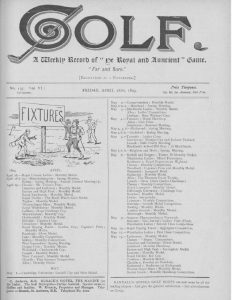
Golf Weekly, 28th April, 1893.
From Club Competition to a National Championship
The first Ladies’ Golf Union Championship was played in June 1893, at Royal Lytham St Anne’s, creating a competition through which leading women golfers from different clubs could compete against one another under an agreed structure.
The championship became an important part of women’s competitive golf, but it sat at the top of something much larger – the network of clubs and competitions through which women participated in the game.
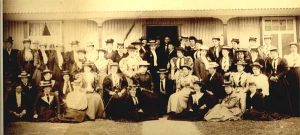
Competitors at the LGU national championship in 1894 at Littlestone in Kent, UK.
Making Handicaps Work Across Different Courses
Creating competition between clubs presented another challenge.
A player’s handicap could recognise her individual playing ability, but golfers were now travelling between courses of very different difficulty. A handicap developed at one club could not simply be assumed to mean the same thing everywhere.
Women involved in the Ladies’ Golf Union developed and formalised a system that considered both the ability of the player and the difficulty of the course.
Courses were assessed so that differences between them could be recognised – an early form of course rating.
This allowed handicaps to become transferable beyond an individual club and made fair competition across a network of different courses possible.
The system was subsequently developed and refined with men and adapted for the men’s game.
Participation Driving Innovation
The importance of the handicap system goes beyond golf administration.
Women had identified a practical problem created by growing participation: how could golfers of different abilities, from different clubs and playing different courses, compete fairly with one another?
They developed a system to solve it.
As participation expanded, women did not simply fit themselves into an existing system. They helped create the systems that allowed participation and competition to grow.
1890s
Different Countries, Different Pathways
By the 1890s, organised women’s golf was developing internationally.
It did not follow a single model.
In Britain and Ireland, women had established their own clubs and competitions and, in 1893, created the Ladies’ Golf Union to coordinate a growing network.
In the United States, a different structure emerged. The United States Golf Association was formed in 1894 and the first U.S. Women’s Amateur Championship followed in 1895, placing women’s championship golf within the national governing structure from its early years.
In Australia, women were part of golf’s development from the early years of organised clubs. At Royal Melbourne, founded in 1891, women were included as associate members from the outset, demonstrating another model in which women’s participation developed within an emerging club structure.
In Sweden, golf was introduced at Ryfors in 1888, when the country’s first course was created by Robert and Edvard Sager. Ida Sager was among its earliest players and is recorded as making the historic first tee shot there in 1888. Women were therefore present at the very beginning of Sweden’s documented golf story.
Across countries, the structures differed, but the pattern was increasingly familiar:
Women played. Women organised. Women competed. Women created communities in which others could participate and belong.
1899
Women Write Their Own Story
By the end of the nineteenth century, women were not only playing and organising golf. They were writing about it.
Our Lady of the Green, published in 1899 with an introduction by Issette Pearson, provides a contemporary record of women’s golf and the community developing around it.
Its importance to 160 Years is that women’s golf was beginning to have not only its own clubs, competitions and structures, but also its own recorded voice and culture.
Link to Our Lady of the Green – Google Book – read for free here
1893 – 1914
Communities, Connections and New Ways to Belong
As women’s golf expanded, the club was no longer the only community through which women could participate.
Women began creating golf associations around their professions, public lives and shared connections. These provided additional opportunities to play and compete, while creating networks between women whose lives extended beyond their individual golf clubs.
The United Services Ladies’ Golf Club, formed at Gosport in 1893, brought together women associated with the military services.
Other associations followed.
In 1911, the Ladies’ Parliamentary Golfing Association was established for women connected with the Houses of Parliament, and the Ladies’ Medical Golf Society created a golfing community around women in medicine.
In 1912, the Ladies’ Legal Golf Association was formed, connecting women through the legal profession.
These were more than additional competitions.
They demonstrate how women used golf to create overlapping communities of participation and belonging — through their clubs, professions, families, interests and wider lives.
1912 — Communities Connect
The creation of the Wilton Cup brought the Ladies’ Parliamentary, Medical, Legal and United Services golf associations together in an inter-association scratch competition, stilled played today.
A network had developed within the network.
Women who belonged to different communities could now meet and compete through a shared event, building relationships between the organisations they had created.
The competition endured, and in later years the Southern Veteran Ladies Golf Association joined it — connecting professional and occupational golfing communities with the senior women’s game.
Competition Created Connection
At the same time, women’s championship golf was increasingly bringing golfers together internationally.
The 1905 Ladies’ Championship at Royal Cromer provides a striking example. International matches between the Home Nations were played around the Championship, and visiting American golfers joined in.
This was not yet the formal international structure that the Curtis Cup would eventually provide.
But the relationships already existed.
Women were travelling, competing, meeting one another and creating friendships across national boundaries.
Golf Was Becoming a Network of Networks
By the years before the First World War, a woman could belong to more than one golfing community.
She could be:
- a member of her club;
- part of a local or regional competitive network;
- connected through her profession or wider life;
- a national competitor;
- and increasingly part of an international community.
Participation was creating connections. Connections created communities. Communities created belonging.
1913 – 1927
Building Participation Across Generations
As women’s golf grew, women began creating structures not simply to support those already playing, but to ensure that participation could continue across generations and throughout life.
Opportunities were created for girls entering the game, for women competing through clubs and associations, and for older women who wanted to continue playing and competing.
Women were building more than a competition structure.
They were creating pathways for lifelong participation and belonging.
1913
Encouraging the Next Generation
In 1913, The Gentlewoman established the Girls’ Open Golf Championship, specifically intended to encourage golf among younger players.
Open to girls up to the age of 18 from the United Kingdom, the British Colonies and other countries, the Championship created a competitive opportunity for a new generation of golfers.
The First World War interrupted its early development, but the Championship was revived in 1919.
Its return mattered.
Despite the disruption of war, the pathway created for girls was not abandoned. Women’s golf resumed not simply by rebuilding existing competitions, but by continuing to create opportunities for those who would follow.
1921
Creating a Place to Continue
At the other end of the life course, women were asking a different question:
How could women continue to participate and compete as they grew older?
In 1921, Mabel Stringer founded the Veteran Ladies Golf Association, creating organised golf for women aged 50 and over.
The Association established its own leadership, committees, meetings and competitions and quickly attracted women who wanted to continue playing competitive golf.
Its first President was 92 years old and was reported as still able to drive a golf ball 90 yards.
This was not simply golf for former competitors.
It was recognition that participation did not need to end because a woman had reached a particular age. The senior women associations still trhive today with many elite players honing their competitive edge within and beyond the associations in the UK and beyond.
Golf provides competition, friendship and belonging throughout life.
1923
From Championship to Community
The pathway created through the Girls’ Open developed further with the formation of the Girls Golfing Society.
Membership came through acceptance to the Girls’ Open Championship, connecting young golfers beyond the competition itself.
Joyce Wethered became its first President, and Mabel Stringer endowed the Society with a scratch challenge cup.
A championship had therefore become something more enduring:
a community.
Girls could meet, compete, develop relationships and become part of a network within women’s golf.
The same period saw other golfing associations emerge around shared interests and identities, further extending the different communities through which women could participate.
1927
Participation at Scale
By 1927, the system women had been building for generations had reached remarkable scale.
The Ladies’ Golf Union represented more than 1,000 affiliated clubs and over 100,000 women golfers in Britain and Ireland, alongside a substantial and growing network of affiliated clubs overseas.
Women’s organised golf now connected clubs and communities across national boundaries.
The significance of those numbers is not simply growth.
Behind them were generations of women who had created:
- opportunities to begin playing;
- competitions for different abilities;
- pathways for girls;
- opportunities to continue competing in later life;
- clubs and associations through which women could organise and volunteer;
- local, national and international networks through which friendships could develop.
Women’s golf had become a participation system across generations — creating opportunities to start, compete, contribute, continue and belong.
1927 – 1950
International Friendship, Rivalry and Continuity
By the late 1920s, women’s golf had developed extensive national and international networks.
Leading players travelled to compete across borders, while relationships between golfers and organisations increasingly created opportunities for international team competition.
Roots: 1905 – 1932
From Friendship to the Curtis Cup
The roots of the Curtis Cup can be traced back much earlier than its first official match.
At the 1905 Ladies’ Championship at Royal Cromer, women from the Home Nations had been playing international matches around the Championship.
When the American Curtis sisters, Harriot and Margaret, travelled to Britain to compete, they were invited to join the matches.
Women from different countries were already finding ways to play together — creating international competition through the relationships and friendships developing around the game.
The experience at Cromer helped sow the seeds of an idea for a more formal international competition between women golfers from Britain and Ireland and the United States.
1932
The Curtis Cup
Twenty-seven years later, the first official Curtis Cup match was played at Wentworth between teams representing the United States and Great Britain & Ireland.
The trophy, donated by Harriot and Margaret Curtis, carried an inscription that captured the spirit behind the competition:
“To stimulate friendly rivalry among the women golfers of many lands.”
The Curtis Cup therefore did not create international relationships in women’s golf.
It formalised relationships that women had already been creating through participation, competition and friendship.
War, Disruption and Continuity
The Second World War again interrupted organised competition.
But the structures and communities women had built survived.
After the war, clubs, championships and associations resumed, demonstrating something that had become a recurring feature of women’s golf:
Organisations could be interrupted. Participation and community created continuity.
1950s – 1978
The Emergence of Professional Pathways
Women’s golf had already developed a strong participation system through clubs, competitions and amateur structures.
The creation of professional pathways added a new dimension to the women’s game.
In the United States, the formation of the LPGA in 1950 created a dedicated professional tour for women golfers, building on the achievements of earlier women professionals and creating new opportunities for elite competition.
In Britain and Europe, professional women’s golf developed later. The launch of the Women’s British Open in 1976 and the formation of the Ladies European Tour in 1978 created a European professional pathway.
These developments were important milestones in women’s golf history — creating opportunities for women to compete at the highest level.
They also marked the emergence of two connected but different pathways:
- Participation pathways — clubs, communities and lifelong involvement.
- Performance pathways — elite competition and professional careers.
Both have contributed to the continuing story of women’s golf.
1978 – 2010
Participation Continues to Evolve
The growth of professional golf did not replace the participation system that had developed over the previous century.
Women continued to play through clubs, national and regional associations, inter-club competitions, senior golf, international matches and informal golfing communities.
At the same time, social change was reshaping women’s lives. Work, family, leisure and expectations were changing, and golf participation continued to adapt alongside them.
New generations entered the game while existing golfers continued to compete, organise, volunteer and create opportunities for others.
Professional golf became increasingly visible, but the foundations of women’s golf remained the thousands of women participating through clubs and communities.
2011 – 2017
A Changing Governance Landscape
For much of its history, women’s golf developed through its own organisations, structures and leadership networks.
During the early 21st century, many national governing bodies began to integrate men’s and women’s golf administration.
In England, the English Women’s Golf Association (EWGA) merged with the English Golf Union (EGU) in 2011 to create a unified national governing body, England Golf.
Other countries followed their own paths, with women’s golf structures integrating into wider governing bodies at different times and in different ways.
In 2017, the Ladies’ Golf Union (LGU) merged with The R&A, bringing together two historic organisations within one governance structure.
These changes created new opportunities for coordination and shared resources, but they also marked a significant transition: organisations that had been created and led by women for generations became part of broader governing systems.
2017 – 2027
New Communities, New Ways to Participate
The structures through which women participate in golf continue to change.
Alongside traditional clubs, competitions and governing bodies, women are creating new communities through social golf, independent groups and digital networks.
These communities may look different from those created by women in the nineteenth and twentieth centuries, but many respond to familiar needs: opportunities to play, meet others, compete, organise and belong.
Technology has made it possible for communities to develop beyond the boundaries of an individual golf club, connecting women locally, nationally and internationally.
The structure has changed again.
The underlying human need has not.
Women continue to create the communities and opportunities they need to participate and belong.
2027 – 160 Years
160 years after women at St Andrews organised their first club medal, golf clubs around the world are invited to explore their own part in this shared history.
The story does not belong to one organisation, one country or a handful of celebrated players.
It belongs to generations of women who played, competed, organised, volunteered, innovated, formed friendships and created opportunities for those who followed.
Their stories can be found in club minutes and photographs, trophies and newspaper reports — and in the memories of the people who were there.